About
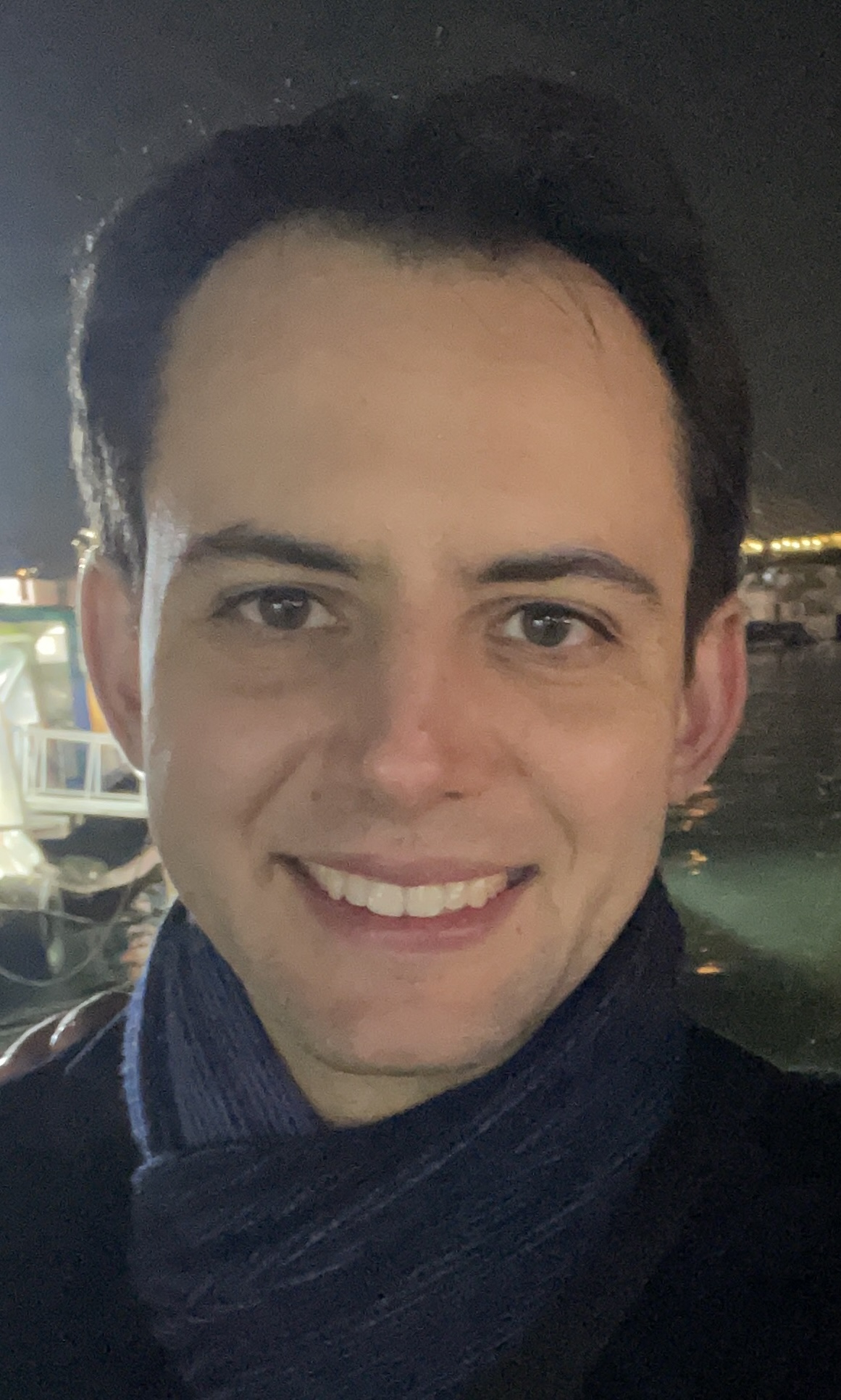
Datalogos is an individual enterprise by Dr. Daniele Gregori.
Daniele holds a Ph.D. in theoretical and mathematical physics from the University of Bologna, often acknowledged as the oldest university of Europe (founded around A.D. 1088). He graduated in October 2022 — just before the launch of ChatGPT — and he is proud of the mental effort he had to spend in writing his dissertation.
His main original discovery has been that the quasinormal modes frequencies of black holes can be computed from non-linear integral equations of the Thermodynamic Bethe Ansatz type. For this he received the Best Poster Award at the international conference Integrability in Gauge and String Theory held in July 2022 (Budapest, Hungary).
Afterwards Dr. Gregori has been postdoctoral researcher at the Nordic Institute for Theoretical Physics (Stockholm, Sweden) for all 2023 and then at the Institute for Advanced Studies of Soochow University (Suzhou, China) until September 2024. However, since his bachelor degree, his intellectual interests progressively shifted from physics to mathematics and finally to computation.*
The decisive turning point for him has been the publication of the package ArXivExplore, whose aim is to “help the deep data analysis of all research articles on arXiv”. Even though he developed this still merely as an academic researcher (rather than as a software engineer), he had the honor to present it at the Wolfram Technology Conference in October 2024.
Came back in Italy, he decided to become a freelance developer and founded Datalogos, which is formally registered at the Chamber of Commerce of Bergamo since January 2025. Thanks to a handful of trusted customers, this work gave Daniele the precious opportunity to increase his mastery of data analysis. More recently he also got involved in web development and infrastructure management and he is eager to learn these too.
Dr. Daniele Gregori feels complete continuity between his former academic and his present commercial work. Indeed in trying to solve the concrete world problems of his clients, he often gets a lot of ideas for the design of high level functions. Thankfully he also finds time to implement some of these — which eventually end up extending the Wolfram Computational Language as well as the Python Package Index.
CV
CV PDF (Aug 2026) — Curriculum Vitae of Dr. Daniele Gregori.
Websites
danielegregori.com — Personal website collecting publications, presentations and blog.
unibo.it — Academic website showing research and teaching activities.
Portfolio
INSPIRE — Academic publications in theoretical and mathematical physics.
GitHub — Open-source packages, resources and other software development work.
Notes
*In the Wolfram community, “computation” means the large scale deployment of mathematical algorithms, thus in a sense the generalization of mathematics through the use of computers.